
Mushrooms are as mysteriously unique as they are delicious. While often thought of as a vegetable and prepared like one, mushrooms are actually fungi, a special type of living organism that has no roots, leaves, flowers or seeds. While they can be cultivated, they easily grow wild in many regions of the world. Reference: http://www.whfoods.com/genpage.php?tname=foodspice&dbid=97#descr


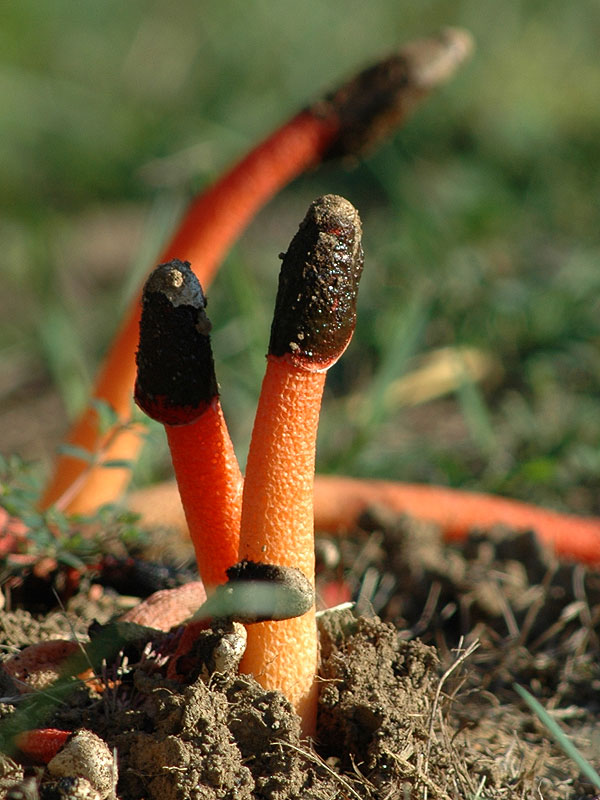 Dozens of varieties of edible mushrooms appear in the spring, but there's no doubt that the wild morel mushroom is the star of the season. Despite their spongy, almost alien appearance, morel mushrooms have a delicate texture and a rich, earthy flavor that some describe as not unlike a fine steak. Morels are so prized that fresh specimens often command upwards of $50 a pound. Luckily, these gourmet fungi can be found in most wooded areas of the United States; they're also remarkably easy to identify, which makes morels a perfect choice for the beginning mushroom hunter.
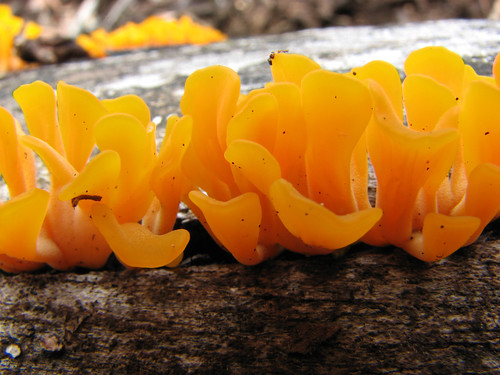
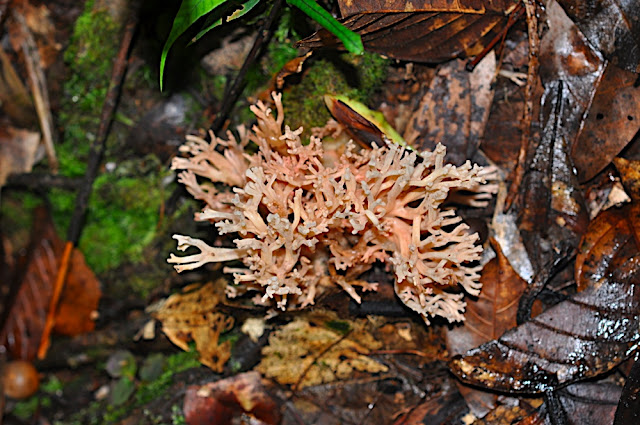
| Kingdom: | Fungi |
| Phylum: | Basidiomycota |
| Subphylum: | Agaricomycotina |
| Class: | Dacrymycetes |
| Family: | Dacrymycetaceae |
| Genus: | Dacryopinax |
| Species: | D. spathularia |
| Binomial name | |
|---|---|
| Dacryopinax spathularia (Schwein.) G.W. Martin (1948) | |
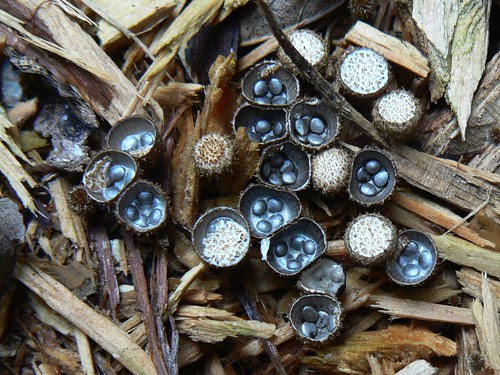

 Lactarius indigo, commonly known as the indigo milk cap, the indigo Lactarius or the blue Lactarius, is a species of fungus in the Russulaceae family of mushrooms. A widely distributed species, it grows naturally in eastern North America, East Asia, and Central America. L. indigo grows on the ground in both deciduous and coniferous forests, where it forms mycorrhizal associations with a broad range of trees. The fruiting body color ranges from dark blue in fresh specimens to pale blue-gray in older ones. The milk, or latex, that oozes when the mushroom tissue is cut or broken—a feature common to all members of the Lactarius genus—is also indigo blue, but slowly turns green upon exposure to air.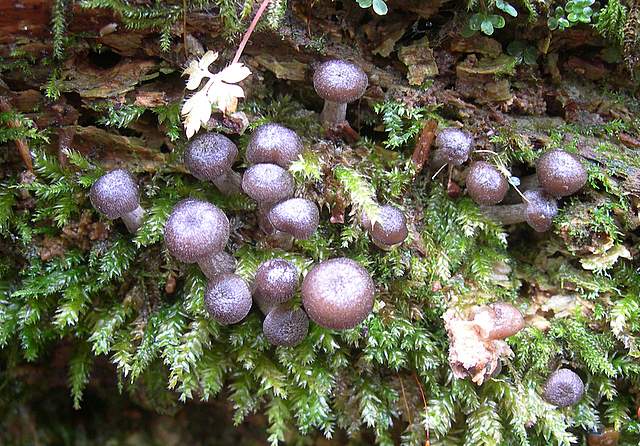
| location: North America | ||
| edibility: Poisonous/Suspect | ||
| fungus colour: White to cream, Grey to beige | ||
| normal size: Less than 5cm | ||
| cap type: Convex to shield shaped | ||
| stem type: Simple stem | ||
| flesh: Flesh fibrous usually pliable (like grass) | ||
| spore colour: White, cream or yellowish | ||
| habitat: Grows in woods, Grows on wood | ||
 | ||
Clitocybula familia (Pk.) Singer Cap 1-4cm across, bell-shaped then convex becoming flatter, with an incurved margin that spreads and finally becomes torn in age; grayish buff to brownish buff or dirty cream; smooth, moist. Gills adnate to nearly free, crowded, narrow; ash gray to whitish. Stem 40-80 x 1.5-3mm, fragile, gray or whitish, with flat white hairs on the base; smooth with a fine bloom. Flesh thin, fragile. Taste slightly disagreeable. Spores globose, smooth, amyloid, 3.5-4.5 x 3.5-4.5µ. Deposit white. Habitat in large clusters on conifer logs. Often abundant. Found widely distributed in North America. Season August-October. Said to be edible. | ||
|


